
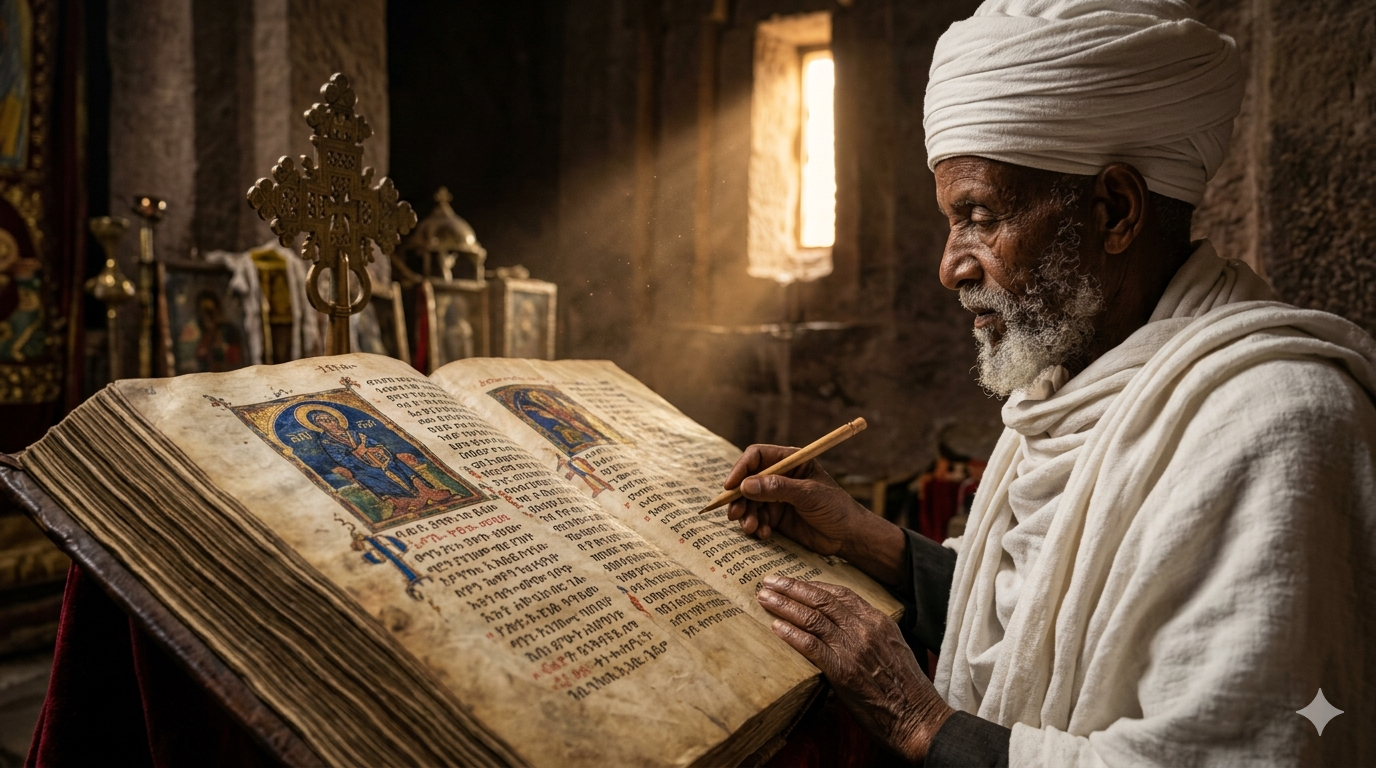
The question of whether the Ethiopian Bible is “accurate” depends entirely on how you define accuracy: historical preservation, archaeological consistency, or theological completeness. As the oldest and most complete Bible still in continuous use, the Ethiopian Orthodox Tewahedo Church (EOTC) canon contains 81 books—nearly 15 more than the standard Protestant Bible. This article examines the evidence for its accuracy and why it remains a focal point for biblical scholars worldwide.
“If ‘accuracy’ means preserving the fullest early Christian library without later cuts, the Ethiopian Bible—with its 81‑book canon, ancient Garima Gospels, and Ge’ez‑preserved texts like Enoch and Jubilees—stands as the most comprehensive and historically stable witness to the biblical tradition we have today.”
1. Historical Antiquity: The Garima Gospels
When measuring accuracy by age, Ethiopia holds a major advantage: the Garima Gospels. For decades, Western scholars dated these manuscripts to the 11th century, but recent carbon dating places them between 330 and 650 AD, making them the oldest illustrated Christian manuscripts in existence—centuries ahead of many European codices.
Accuracy note: The high‑altitude monasteries of Ethiopia shielded these texts from the political “purges,” linguistic shifts, and recensions that reshaped Western Bibles, resulting in an unusually stable transmission.
2. 81 Books vs. Western 66
The Ethiopian Bible is often called “more accurate” by its adherents precisely because it never removed books that were widely used in the early Church. While the Protestant Reformation culled several texts (the Apocrypha), Ethiopia preserved two canonical streams: the Broader Canon and the Narrower Canon.
Comparative Canon Table
| Feature | Protestant Bible | Catholic Bible | Ethiopian Bible (EOTC) |
|---|---|---|---|
| Total Books | 66 | 73 | 81 |
| Book of Enoch | No | No | Yes |
| Book of Jubilees | No | No | Yes |
| Metsihafe Kidan | No | No | Yes |
This expanded collection reflects a broader early Christian library, not just a later Western reduction.
3. Archaeological Validation: The Dead Sea Scrolls
The strongest archaeological argument for the accuracy of the Ethiopian Bible came in 1947 with the Dead Sea Scrolls. Before their discovery, the Book of Enoch and the Book of Jubilees were known mainly through their Ge’ez translations in Ethiopia. Many scholars dismissed them as late “fabrications.”
The scrolls, however, revealed fragments of Enoch and Jubilees in Aramaic and Hebrew that closely match the Ge’ez versions preserved in Ethiopia for over 1,600 years.
Key takeaway: Ethiopia did not fabricate these texts; it helped preserve them, offering a remarkably high degree of scribal accuracy across centuries.
4. Linguistic Precision: The Ge’ez Language
The Ethiopian Bible is written in Ge’ez, a Semitic language closely related to Hebrew and Aramaic. Scholars argue that Ge’ez captures Semitic nuances—rhythm, parallelism, and theological shading—better than later Greek or Latin translations that shaped Western Bibles.
Because Ethiopia was never colonized in a way that forced a wholesale linguistic overhaul of its scriptures, the transition from ancient oral tradition to written Ge’ez is considered unusually direct and conservative.
5. Is It “Accurate” or Just “Different”?
From a scholarly perspective, “accuracy” usually refers to textual transmission rather than metaphysical inspiration.
- Western perspective: Often treats the 66‑book Protestant canon as the inspired Word, viewing extra‑canonical books as historically valuable but not doctrinally binding.
- Ethiopian perspective: Sees the removal of books such as Enoch (quoted in Jude 1:14–15) as an omission—potentially obscuring the fuller divine record.
Both sides agree on one point: the Ethiopian Bible preserves a wider slice of early Christian literature than most Western traditions.
FAQ: Quick Answers for Search Intent
Why does the Ethiopian Bible have more books?
It includes texts that were used by early Christians but later excluded by Roman and Protestant councils for theological and political reasons.
Is the Ethiopian Bible the oldest Bible in the world?
Yes, in terms of complete collections and surviving illustrated manuscripts (like the Garima Gospels), it is among the oldest continuously used Bibles in the world.
Can I trust the Ge’ez–Amharic–English translations?
The EOTC treats these translations with extreme care, but because the canon includes books like 1 Enoch, the content can feel strikingly different from the “standard” Bible—more apocalyptic and less streamlined.
A Benchmark of Preservation
If accuracy is defined by the ability to preserve ancient texts without alteration or omission, the Ethiopian Bible is arguably the most accurate witness to the earliest Christian library. It functions as a time capsule, retaining the apocalyptic and liturgical works that shaped the faith of believers in the 1st and 2nd centuries.
For anyone seeking the fullest available version of the biblical narrative, the Ethiopian 81‑book canon stands as an essential primary source.
How does the Book of Enoch change your understanding of the biblical timeline?
Including the Book of Enoch invites a much more expansive pre‑New Testament cosmology into the biblical timeline. It reshapes the narrative around the fall of the Watchers, the origin of evil, and the structure of the heavens, all of which stand in the background of Jude and parts of the Synoptic Gospels. Instead of a “clean” jump from Genesis to the Gospels, the Ethiopian canon presents a denser, more layered cosmic history—one that feels closer to the worldview of 1st‑century Jewish‑Christian communities than to the streamlined order of modern Western Bibles.