

The Bible used by the Ethiopian Orthodox Tewahedo Church is the oldest and largest in the world. While the King James Version (KJV) is the gold standard for English-speaking Protestants, the differences between the two are significant, spanning from the number of books to the very language of the source texts.
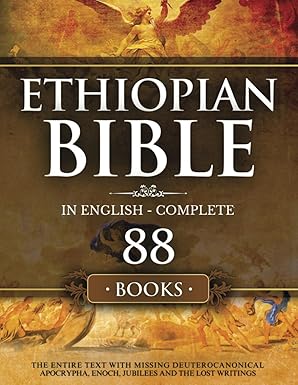
Download the Ethiopian Bible 88 books in English PDF
1. The Numbers: 66 vs. 81 (or 88)
The most striking difference is the sheer volume of the “Broader Canon.”
- KJV: Contains 66 books (39 Old Testament, 27 New Testament).
- Ethiopian Orthodox: Contains 81 books in its official liturgical canon. This is divided into the Narrower Canon and the Broader Canon (which can sometimes be counted as 88 depending on how the books of Clement and the Covenant are separated).
Comparison Table: At a Glance
| Feature | King James Version (KJV) | Ethiopian Orthodox Bible |
| Total Books | 66 | 81 (Narrow) / 88 (Broad) |
| Old Testament | 39 | 46 (or 53) |
| New Testament | 27 | 35 |
| Source Language | Masoretic (Hebrew) / Greek | Ge’ez (Ancient Ethiopic) |
| Apocrypha | Usually Excluded | Fully Integrated & Inspired |
2. Key “Missing” Books in the KJV
The Ethiopian Bible contains several ancient texts that were never included in the KJV or were removed during the Reformation. These are not “extra” to the Ethiopian Church; they are considered divinely inspired.
The Book of Enoch (Henok)
This is the most famous difference. The Ethiopian Bible is the only Bible in the world to preserve the Book of Enoch in its entirety. It provides deep context on the “Nephilim,” the fall of the watchers, and Messianic prophecies that are quoted directly in the New Testament (Jude 1:14-15).
The Book of Jubilees (Kufale)
Known as the “Lesser Genesis,” this book provides a much more detailed account of the days of creation and the lives of the Patriarchs, often providing specific dates and years for events that Genesis covers broadly.
The Meqabyan (Ethiopian Maccabees)
Warning: These are distinct from the Roman Catholic Books of Maccabees. The Ethiopian Meqabyan (1, 2, and 3) tell the story of different martyrs who remained faithful to God under the pressure of pagan kings.
3. New Testament Differences
While the 27 books of the KJV New Testament are all present in the Ethiopian Bible, the Ethiopian Church adds 8 additional books of church order and discipline, known as the Ethiopic Clementine and the Didascalia. These books focus on:
- Ecclesiastical rules and church hierarchy.
- Instructions for baptism and the liturgy.
- The “Covenant” (Meqidan)—teachings of Jesus to the Apostles after the Resurrection.
4. Linguistic and Theological Nuance
- The Ge’ez Connection: The Ethiopian Bible is translated into Ge’ez, an ancient Semitic language. Because Ge’ez is closely related to Hebrew and Aramaic, many scholars argue that the Ethiopian version preserves nuances lost in the Latin or English translations of the KJV.
- The Nature of Christ: The Ethiopian Bible supports a Miaphysite Christology (one nature of Christ), whereas the KJV was translated within a Western tradition following the Council of Chalcedon (two natures). This subtly influences how certain verses regarding the divinity of Christ are emphasized.
5. Summary: Which one should you read?
If you are looking for the historical foundation of English literature and Protestant theology, the KJV is essential. However, if you want to see the most ancient, expansive, and preserved version of the Christian scriptures—including books that were lost to the West for centuries—the Ethiopian Orthodox Bible is a necessary study.